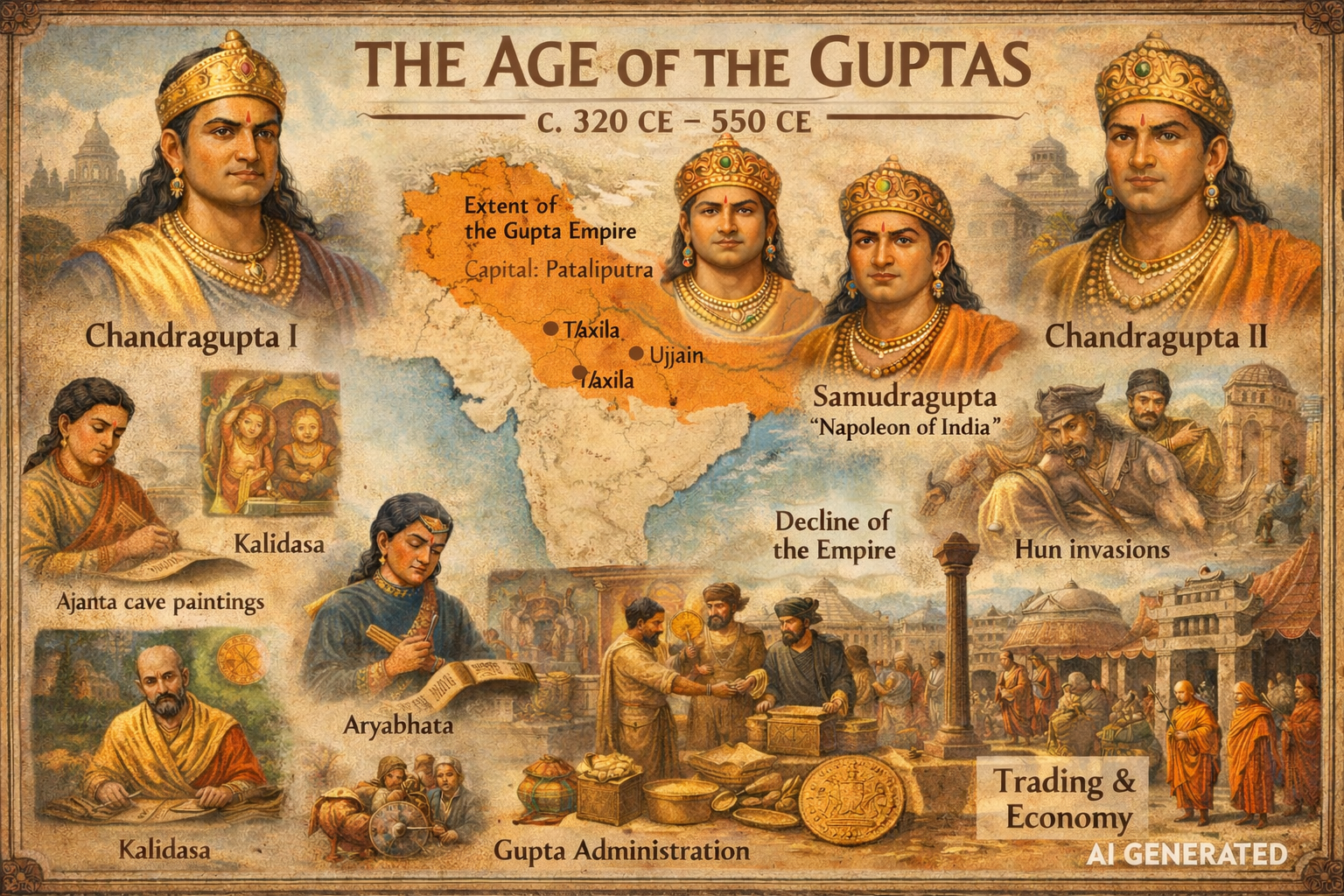
ICSE CLASS 9 HISTORY THE GUPTA EMPIRE QUESTIONS AND ANSWERS
Imagine a time when India was among the wealthiest and most culturally vibrant regions on earth. That was the era of the Gupta Period, often called the Golden Age of India. Let us discuss this era through questions and answers in my blog ICSE class 9 history The Gupta Empire questions and answers.
A. MULTIPLE-CHOICE QUESTIONS FOR ICSE CLASS 9 HISTORY THE GUPTA EMPIRE QUESTIONS AND ANSWERS
I. Choose the correct answers to the questions from the given options.
1. Which factor most directly contributed to the political stability of the Gupta Empire?
(a) Strict military rule
(b) Efficient provincial administration
(c) Continuous territorial expansion
(d) Complete absence of local rulers
Answer: (b)
2. The Guptas are described as having a “decentralised administration” mainly because:
(a) Provinces were ruled independently
(b) Local bodies had considerable autonomy
(c) Kings avoided interference in governance
(d) Military governors controlled all regions
Answer: (b)
3. Which evidence best supports the claim that trade flourished during the Gupta period?
(a) Growth of land grants
(b) Issue of gold coins
(c) Decline of foreign invasions
(d) Increase in agricultural taxes
Answer: (b)
4. Samudragupta’s Allahabad Pillar Inscription is historically significant because it:
(a) Describes religious practices of the Guptas
(b) Records land revenue systems
(c) Gives a detailed account of his conquests
(d) Explains village administration
Answer: (c)
5. The decline of the Gupta Empire can be best explained by:
(a) Weak religious policies
(b) Continuous wars with the Cholas
(c) Hun invasions and weak successors
(d) Decline in art and culture
Answer: (c)
6. Which comparison best highlights a difference between Mauryan and Gupta administration?
(a) Mauryas were monarchs; Guptas were republicans
(b) Mauryas followed decentralisation; Guptas followed centralisation
(c) Mauryas relied on espionage; Guptas relied on local officials
(d) Mauryas issued gold coins; Guptas did not
Answer: (c)
7. The Gupta period is called a “Golden Age” mainly because of:
(a) Expansion of the empire
(b) Foreign trade dominance
(c) Achievements in art, science, and literature
(d) Absence of wars
Answer: (c)
8. Which Gupta ruler is best remembered for patronising scholars like Kalidasa?
(a) Samudragupta
(b) Chandragupta I
(c) Chandragupta II
(d) Skandagupta
Answer: (c)
9. The Ajanta cave paintings indicate that Gupta artists had mastery over:
(a) Religious symbolism only
(b) Use of bright synthetic colours
(c) Expression of human emotions and natural scenes
(d) Abstract and geometric designs
Answer: (c)
10. Which statement best explains the importance of land grants during the Gupta period?
(a) They weakened the king’s authority
(b) They promoted trade over agriculture
(c) They encouraged agricultural expansion and administration
(d) They eliminated the need for taxation
Answer: (c)
11. The Gupta rulers followed a policy of religious tolerance, which is evident from:
(a) Exclusive promotion of Buddhism
(b) Persecution of Jain monks
(c) Patronage of Hinduism along with Buddhism and Jainism
(d) Abolition of religious institutions
Answer: (c)
12. Which conclusion can be drawn about Gupta economy from the circulation of gold coins but fewer silver coins?
(a) The economy was agrarian only
(b) Foreign trade was insignificant
(c) The empire had surplus wealth and prosperous trade
(d) Currency was rarely used
Answer: (c)
II. Read the two statements given below and select the option that shows the correct relationship between (A) and (R).
1.
Assertion (A): The Gupta period is regarded as the Golden Age of ancient India.
Reason (R): There were remarkable achievements in art, literature, science, and administration during this period.
(a) Both A and R are true, and R is the correct explanation of A.
(b) Both A and R are true, but R is not the correct explanation of A.
(c) A is true, but R is false.
(d) A is false, but R is true.
Answer: (a)
2.
Assertion (A): Samudragupta is known as the “Napoleon of India.”
Reason (R): He conquered territories through both war and diplomatic policies.
(a) Both A and R are true, and R is the correct explanation of A.
(b) Both A and R are true, but R is not the correct explanation of A.
(c) A is true, but R is false.
(d) A is false, but R is true.
Answer: (a)
3.
Assertion (A): The Gupta administration was less centralised than that of the Mauryas.
Reason (R): Local bodies such as village assemblies and district councils had significant powers.
(a) Both A and R are true, and R is the correct explanation of A.
(b) Both A and R are true, but R is not the correct explanation of A.
(c) A is true, but R is false.
(d) A is false, but R is true.
Answer: (a)
4.
Assertion (A): Gold coins were widely issued during the Gupta period.
Reason (R): The Gupta economy was supported by flourishing internal and external trade.
(a) Both A and R are true, and R is the correct explanation of A.
(b) Both A and R are true, but R is not the correct explanation of A.
(c) A is true, but R is false.
(d) A is false, but R is true.
Answer: (a)
5.
Assertion (A): Chandragupta II strengthened the Gupta Empire without constant warfare.
Reason (R): He followed a policy of matrimonial alliances and diplomacy.
(a) Both A and R are true, and R is the correct explanation of A.
(b) Both A and R are true, but R is not the correct explanation of A.
(c) A is true, but R is false.
(d) A is false, but R is true.
Answer: (a)
6.
Assertion (A): The Allahabad Pillar Inscription is an important historical source for the Gupta period.
Reason (R): It provides a detailed account of Samudragupta’s conquests and achievements.
(a) Both A and R are true, and R is the correct explanation of A.
(b) Both A and R are true, but R is not the correct explanation of A.
(c) A is true, but R is false.
(d) A is false, but R is true.
Answer: (a)
7.
Assertion (A): Art and architecture reached a high level of excellence during the Gupta period.
Reason (R): The rulers discouraged religious themes in artistic expression.
(a) Both A and R are true, and R is the correct explanation of A.
(b) Both A and R are true, but R is not the correct explanation of A.
(c) A is true, but R is false.
(d) A is false, but R is true.
Answer: (c)
8.
Assertion (A): Religious tolerance was an important feature of Gupta rule.
Reason (R): The Gupta rulers patronised Hinduism while also supporting Buddhism and Jainism.
(a) Both A and R are true, and R is the correct explanation of A.
(b) Both A and R are true, but R is not the correct explanation of A.
(c) A is true, but R is false.
(d) A is false, but R is true.
Answer: (a)
9.
Assertion (A): The Hun invasions played a major role in the decline of the Gupta Empire.
Reason (R): The continuous invasions weakened the empire’s economy and military strength.
(a) Both A and R are true, and R is the correct explanation of A.
(b) Both A and R are true, but R is not the correct explanation of A.
(c) A is true, but R is false.
(d) A is false, but R is true.
Answer: (a)
10.
Assertion (A): Land grants became common during the Gupta period.
Reason (R): These grants helped in agricultural expansion and administration of distant areas.
(a) Both A and R are true, and R is the correct explanation of A.
(b) Both A and R are true, but R is not the correct explanation of A.
(c) A is true, but R is false.
(d) A is false, but R is true.
Answer: (a)
11.
Assertion (A): The position of women improved significantly during the Gupta period.
Reason (R): Women were allowed equal rights in political administration.
(a) Both A and R are true, and R is the correct explanation of A.
(b) Both A and R are true, but R is not the correct explanation of A.
(c) A is true, but R is false.
(d) A is false, but R is true.
Answer: (c)
12.
Assertion (A): Sanskrit became the dominant language of administration and literature during the Gupta Age.
Reason (R): Gupta rulers actively patronised Sanskrit scholars and institutions.
(a) Both A and R are true, and R is the correct explanation of A.
(b) Both A and R are true, but R is not the correct explanation of A.
(c) A is true, but R is false.
(d) A is false, but R is true.
Answer: (a)
B. SHORT QUESTIONS FOR ICSE HISTORY FOR CLASS 9 THE GUPTA EMPIRE QUESTIONS AND ANSWERS:
1. Who established the Gupta dynasty? Name one of the early kings of this dynasty.
Answer:
- The Gupta dynasty was founded by Sri Gupta, who initiated Gupta rule in northern India.
- Chandragupta I was one of the early rulers who played an important role in strengthening the dynasty.
2. State any two important sources that provide information about the Gupta period.
Answer:
- The Allahabad Pillar Inscription, which records the achievements of the Gupta ruler Samudragupta.
- Coins issued by the Gupta rulers, which give useful information about their economy and administration.
3. Why is the Gupta age often described as the Golden Age of ancient India? Give two reasons.
Answer:
- There was remarkable progress in learning, literature, and scientific studies during this period.
- Significant developments took place in art, sculpture, and architecture, reflecting a high level of cultural achievement.
4. Identify any two well-known scholars associated with the Gupta period.
Answer:
- Kalidasa, a renowned Sanskrit poet and playwright.
- Aryabhatta, noted for his pioneering work in mathematics and astronomical studies.
5. State two responsibilities of the Kumaramatyas in the Gupta administration.
Answer:
- They assisted the king in managing important administrative affairs.
- They helped in maintaining law, order, and governance within the empire.
6. Name the ruler who defended the Gupta Empire against the Hunas and mention one achievement of his rule.
Answer:
- Skandagupta successfully resisted the Huna invasions.
- He successfully safeguarded the Gupta Empire from foreign invasions for a considerable period.
7. Mention two characteristics of Gupta sculpture.
Answer:
- Sculptures displayed graceful forms and balanced proportions.
- Figures often reflected calm expressions and spiritual depth.
8. What do the gold coins of the Guptas reveal about their economy?
Answer:
- They indicate that the empire possessed considerable wealth and resources.
- They suggest the existence of active trade and commercial activities.
9. State two main occupations of the people during the Gupta period.
Answer:
- Agriculture was the principal occupation of most people.
- Trade and commerce were also important economic activities.
10. State two important features of local administration in villages during the Gupta period.
Answer:
- Villages managed many local matters through village assemblies.
- Local officials were responsible for tax collection and maintaining order.
11. Give two reasons for the weakening of the Gupta Empire.
Answer:
- Repeated attacks by the Hunas weakened the strength of the empire.
- The later Gupta rulers were weak, which led to the gradual loss of central authority.
12. State two ways in which the Gupta rulers promoted religion.
Answer:
- They extended patronage to Hindu temples and religious institutions.
- They also showed tolerance towards Buddhism and Jainism.
C. STRUCTURED – QUESTIONS FOR ICSE CLASS 9 HISTORY THE SANGAM AGE QUESTIONS AND ANSWERS:
Question 1
(a) Who founded the Gupta dynasty? Name an early ruler who helped strengthen this dynasty.
Answer:
- The Gupta dynasty was established by Sri Gupta, who initiated Gupta rule in northern India.
- Chandragupta I was an early ruler who consolidated the power of the dynasty and expanded its influence.
(b) State three important achievements of Samudragupta.
Answer:
- He carried out numerous successful military campaigns, extending the boundaries of the empire.
- Many defeated rulers accepted his overlordship and paid tribute while continuing to rule their territories.
- He was also known for his patronage of music and learning.
(c) Explain four reasons why the Gupta period is regarded as a Golden Age in Indian history.
Answer:
- There was remarkable progress in literature, particularly in Sanskrit works produced by scholars.
- Important developments took place in science and mathematics, leading to new discoveries.
- Art and architecture flourished, producing elegant sculptures and temple designs.
- The empire experienced political stability and economic prosperity, which encouraged cultural growth.
Question 2
(a) Identify any two important sources that provide information about the Gupta period.
Answer:
- The Allahabad Pillar Inscription, which records the achievements of the Gupta ruler Samudragupta.
- Coins issued by the Gupta rulers, which offer evidence about their economy and political authority.
(b) Mention three features of the provincial administration under the Guptas.
Answer:
- The empire was divided into large administrative units called Bhuktis or provinces.
- Each province was governed by an official known as an Uparika, appointed by the king.
- Provinces were further subdivided into districts known as Vishayas for easier administration
(c) Explain four important characteristics of the Gupta economy.
Answer:
- Agriculture formed the main basis of livelihood, with many people engaged in farming.
- Trade and commercial activities continued to play a significant role in economic life.
- The issue of gold coins indicates considerable wealth within the empire.
- Urban centres and markets contributed to the growth of economic activity.
Question 3
(a) Name the Gupta ruler who faced the Huna invasions and state one achievement of his reign.
Answer:
- The ruler who confronted the Huna attacks was Skandagupta.
- He successfully defended the empire from these invasions for a period of time.
(b) Mention three distinguishing features of Gupta sculpture.
Answer:
- Sculptures were noted for their balanced proportions and graceful appearance.
- Artists portrayed figures with serene facial expressions and spiritual calmness.
- Many sculptures represented religious themes, especially Hindu and Buddhist subjects.
(c) Explain four reasons responsible for the decline of the Gupta Empire.
Answer:
- Frequent attacks by the Hunas weakened the empire’s military strength.
- The rulers who succeeded the later Gupta kings were ineffective in maintaining strong control.
- Granting large areas of land to officials and nobles gradually reduced the authority of the central government.
- Several regions began to assert independence, leading to the fragmentation of the empire.
Question 4
(a) Name any two scholars who flourished during the Gupta age.
Answer:
- Kalidasa
- Aryabhata
(b) State three features of the religious policy followed by the Gupta rulers.
Answer:
- The Gupta kings mainly supported Hindu religious traditions.
- At the same time, they followed a policy of religious tolerance towards other faiths.
- Institutions connected with Buddhism and Jainism also received support.
(c) Describe four features of village administration during the Gupta period.
Answer:
- Villages managed many local matters through village assemblies.
- The Grama Sabha played an important role in local decision-making.
- Officials were responsible for collecting taxes and maintaining order in rural areas.
- Villages enjoyed a considerable degree of autonomy in managing their affairs.
Leave a Reply