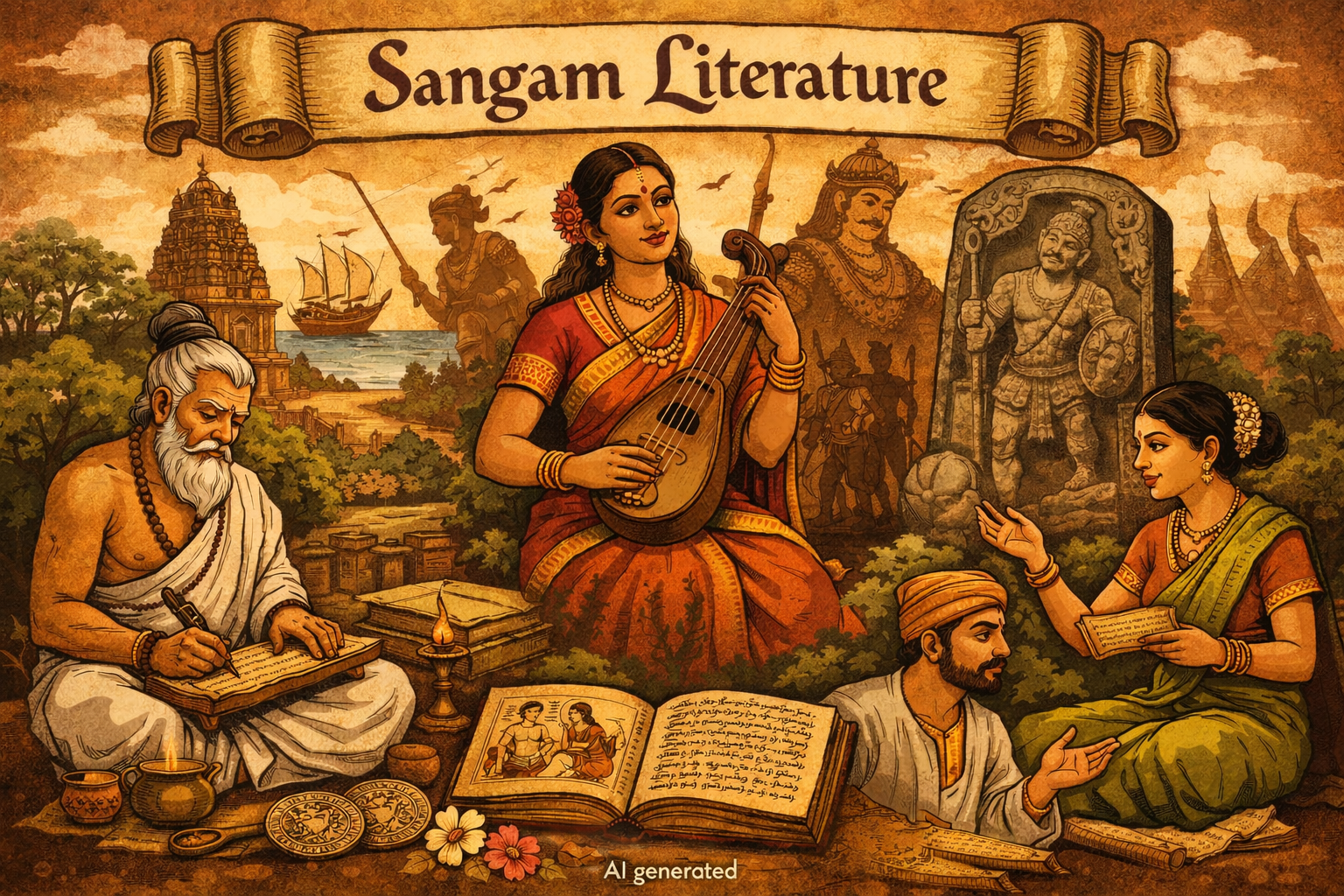
ICSE CLASS 9 HISTORY THE SANGAM AGE QUESTIONS AND ANSWERS
Hello! Here I am again to discuss a new chapter in History. Today’s topic is ICSE class 9 history The Sangam Age questions and answers.
A. MULTIPLE-CHOICE QUESTIONS FOR ICSE CLASS 9 HISTORY THE SANGAM AGE QUESTIONS AND ANSWERS
I. Choose the correct answers to the questions from the given options.
1. Which inference can be drawn about Sangam polity from the fact that kings were advised by the Manram?
(a) Sangam rulers exercised absolute power
(b) Military officers dominated administration
(c) Kings followed a consultative form of governance
(d) Religious leaders controlled the state
Answer: (c) Kings followed a consultative form of governance
2. The classification of land into Tinais suggests that Sangam society:
(a) was rigidly divided on the basis of caste
(b) depended heavily on geography for economic life
(c) lacked political unity
(d) followed a uniform system of administration
Answer: (b) depended heavily on geography for economic life
3. The prominence of ports like Arikamedu indicates that the Sangam economy:
(a) relied only on internal trade
(b) had little contact with rest of the regions of the world
(c) had established overseas commercial contacts
(d) discouraged maritime activities
Answer: (c) had established overseas commercial contacts
4. Karikala Chola’s construction of embankments along the river Kaveri shows that Sangam rulers:
(a) focused mainly on religious activities
(b) promoted agriculture through irrigation measures
(c) were indifferent to peasant welfare
(d) preferred trade over farming
Answer: (b) promoted agriculture through irrigation measures
5. Which conclusion about Sangam society is supported by the presence of warrior heroes and hero stones?
(a) Society was primarily peaceful
(b) Warfare was occasional and unimportant
(c) Valour and bravery were highly respected values
(d) Soldiers were socially inferior
Answer: (c) Valour and bravery were highly respected values
6. The existence of poems praising kings and chieftains implies that Sangam literature was:
(a) purely religious in nature
(b) written only for entertainment
(c) a source of historical and social information
(d) limited to court rituals
Answer: (c) a source of historical and social information
7. Which feature best distinguishes Sangam administration from later imperial systems like the Mauryas?
(a) Use of spies
(b) Emphasis on village self-government
(c) Highly centralized bureaucracy
(d) Codified legal system
Answer: (b) Emphasis on village self-government
8. The importance given to women poets like Avvaiyar suggests that Sangam society:
(a) denied women access to education
(b) restricted women to domestic roles only
(c) allowed women participation in literary life
(d) followed strict patriarchal norms without exception
Answer: (c) allowed women participation in literary life
9. Which of the following best explains the popularity of cattle raids mentioned in Sangam texts?
(a) Religious rituals required cattle sacrifice
(b) Cattle symbolized wealth and economic strength
(c) Agriculture was completely absent
(d) Trade was discouraged
Answer: (b) Cattle symbolized wealth and economic strength
10. The flourishing of craft production and trade guilds indicates that Sangam society:
(a) depended only on barter
(b) lacked economic specialization
(c) had a diversified economy
(d) discouraged urban growth
Answer: (c) had a diversified economy
11. The frequent mention of wars among the Cheras, Cholas, and Pandyas suggests that political power during the Sangam Age was:
(a) hereditary and uncontested
(b) shared equally among kingdoms
(c) unstable and often contested
(d) controlled by religious authorities
Answer: (c) unstable and often contested
12. Which of the following conclusions about the Sangam religion is most accurate?
(a) It was dominated by Vedic rituals alone
(b) It was uniform across all regions
(c) It involved nature worship and hero worship
(d) It rejected all forms of idol worship
Answer: (c) It involved nature worship and hero worship
II. Read the two statements given below and select the option that shows the correct relationship between (A) and (R).
- Assertion (A): The Sangam Age rulers followed a consultative form of administration.
Reason (R): The kings were advised by assemblies known as Manrams.
(a) Both A and R are true, and R is the correct explanation of A
(b) Both A and R are true, but R is not the correct explanation of A
(c) A is true, but R is false
(d) A is false, but R is true
Answer: (a)
- Assertion (A): Agriculture formed the backbone of the Sangam economy.
Reason (R): Sangam rulers paid special attention to irrigation and water management.
(a) Both A and R are true, and R is the correct explanation of A
(b) Both A and R are true, but R is not the correct explanation of A
(c) A is true, but R is false
(d) A is false, but R is true
Answer: (a)
- Assertion (A): The classification of land into Tinais reflects the close relationship between geography and livelihood.
Reason (R): Each Tinai was associated with a particular economic activity and way of life.
(a) Both A and R are true, and R is the correct explanation of A
(b) Both A and R are true, but R is not the correct explanation of A
(c) A is true, but R is false
(d) A is false, but R is true
Answer: (a)
- Assertion (A): The Sangam Age witnessed extensive overseas trade.
Reason (R): Roman coins and pottery have been found at sites like Arikamedu.
(a) Both A and R are true, and R is the correct explanation of A
(b) Both A and R are true, but R is not the correct explanation of A
(c) A is true, but R is false
(d) A is false, but R is true
Answer: (a)
- Assertion (A): Warfare was an important aspect of Sangam political life.
Reason (R): Hero stones were erected to commemorate warriors who died in battle.
(a) Both A and R are true, and R is the correct explanation of A
(b) Both A and R are true, but R is not the correct explanation of A
(c) A is true, but R is false
(d) A is false, but R is true
Answer: (a)
- Assertion (A): Sangam literature is an important source of information about early South Indian history.
Reason (R): It contains references to political events, social life, and economic activities.
(a) Both A and R are true, and R is the correct explanation of A
(b) Both A and R are true, but R is not the correct explanation of A
(c) A is true, but R is false
(d) A is false, but R is true
Answer: (a)
- Assertion (A): Women enjoyed a respected position in Sangam society.
Reason (R): Women like Avvaiyar made significant contributions to Sangam literature.
(a) Both A and R are true, and R is the correct explanation of A
(b) Both A and R are true, but R is not the correct explanation of A
(c) A is true, but R is false
(d) A is false, but R is true
Answer: (a)
- Assertion (A): The Sangam rulers maintained large standing armies.
Reason (R): Frequent wars were fought among the Cheras, Cholas, and Pandyas for territorial expansion.
(a) Both A and R are true, and R is the correct explanation of A
(b) Both A and R are true, but R is not the correct explanation of A
(c) A is true, but R is false
(d) A is false, but R is true
Answer: (b)
- Assertion (A): Trade during the Sangam Age was limited only to local markets.
Reason (R): The existence of ports facilitated contact with foreign traders.
(a) Both A and R are true, and R is the correct explanation of A
(b) Both A and R are true, but R is not the correct explanation of A
(c) A is true, but R is false
(d) A is false, but R is true
Answer: (d)
- Assertion (A): Sangam religious practices included nature worship.
Reason (R): Natural elements like hills, forests, and rivers were associated with deities.
(a) Both A and R are true, and R is the correct explanation of A
(b) Both A and R are true, but R is not the correct explanation of A
(c) A is true, but R is false
(d) A is false, but R is true
Answer: (a)
- Assertion (A): Village assemblies played an important role in Sangam administration.
Reason (R): Local issues were resolved through village-level councils.
(a) Both A and R are true, and R is the correct explanation of A
(b) Both A and R are true, but R is not the correct explanation of A
(c) A is true, but R is false
(d) A is false, but R is true
Answer: (a)
- Assertion (A): The Sangam Age lacked any form of social stratification.
Reason (R): Society was organized according to occupation and region.
(a) Both A and R are true, and R is the correct explanation of A
(b) Both A and R are true, but R is not the correct explanation of A
(c) A is true, but R is false
(d) A is false, but R is true
Answer: (d)
B. SHORT QUESTIONS FOR ICSE HISTORY FOR CLASS 9 THE SANGAM AGE QUESTIONS AND ANSWERS:
1. What is referred to as the Sangam Age?
Answer:
- The Sangam Age refers to the early historical period of South India.
- It is named after the assemblies (Sangams) of Tamil poets held mainly at Madurai.
2. Name the three major dynasties of the Sangam Age.
Answer:
- Cheras
- Cholas
- Pandyas
3. Which language was Sangam literature written in?
Answer:
- Sangam literature was composed in the Tamil language.
- It is regarded as the earliest form of literature in South India.
4. What was the Manram?
Answer:
- The Manram was an advisory body that assisted the king in governance.
- It played an important role in Sangam administration.
5. Name any two important Sangam literary works.
Answer:
- Silappadikaram
- Manimekalai
6. What were Hero Stones?
Answer:
- Hero stones were memorial stones erected for fallen warriors.
- They show the importance of bravery and warfare in Sangam society.
7. Mention any three features of Sangam administration.
Answer:
- Kings ruled with the help of advisory councils like the Manram.
- Village assemblies managed local affairs.
- Justice was based on customs and traditions.
8. State three main occupations of the Sangam people.
Answer:
- Farming was the principal occupation of the people.
- Both internal and overseas trade were well developed.
- Crafts like weaving, metalwork, and pottery were practiced.
9. Explain the importance of agriculture in the Sangam Age.
Answer:
- Agriculture was the backbone of the economy.
- Irrigation works like tanks and canals were constructed.
- Crops such as rice were extensively cultivated.
10. Give three reasons why Sangam literature is considered a valuable historical source.
Answer:
- It provides information about political life and administration.
- It describes social customs and occupations.
- It gives details of trade, religion, and culture.
11. Describe the role of trade during the Sangam Age.
Answer:
- Internal trade was carried on through markets and towns.
- Overseas trade existed with the Romans.
- Ports like Arikamedu were important trade centres.
12. State three features of religion during the Sangam Age.
Answer:
- Nature worship was common.
- Hero worship was practiced.
- Simple forms of worship existed before temple building became common.
13. What do you understand by Tinais? Give one example.
Answer:
- Tinais were divisions of land based on geography and occupation.
- Example: Marudam was associated with agriculture.
C. STRUCTURED – QUESTIONS FOR ICSE CLASS 9 HISTORY THE SANGAM AGE QUESTIONS AND ANSWERS
Question 1
In the context of the Sangam Age, answer the following questions:
(a) What is meant by Sangam literature?
(b) Name the three major dynasties of the Sangam Age and state one feature of each.
(c) Describe four features of Sangam administration.
Answer:
- Sangam literature can be defined as follows:
- Sangam literature refers to a collection of ancient Tamil poems.
- These poems were composed by Tamil poets in assemblies called Sangams.
- They provide information about early South Indian life.
- Three dynasties of the Sangam Age with a feature of each of them is as follows:
- Cheras – Their symbol was the bow.
- Cholas – They were known for their military strength.
- Pandyas – They ruled from Madurai.
- Four features of Sangam administration are as follows:
- The king was the highest authority of the state.
- Kings were advised by councils such as the Manram.
- Village assemblies managed local administration.
- Justice was based on customs and traditions.
Question 2
With reference to the economy of the Sangam Age, answer the following:
(a) State three features of agriculture during the Sangam Age.
(b) Mention three important aspects of trade.
(c) Explain four factors that contributed to the prosperity of the Sangam economy.
Answer:
- Three features of agriculture during the Sangam Age are:
- Agriculture was the main occupation of the people.
- Irrigation was developed using tanks and canals.
- Rice formed the major crop grown by the people.
- Three important aspects of trade are:
- Both inland and overseas trade were carried on.
- Ports like Arikamedu were important trade centres.
- Roman traders had commercial contacts with South India.
- Four factors that contributed to the prosperity of the Sangam economy are:
- Fertile river valleys helped in the development of agriculture.
- Well-developed irrigation increased production.
- Skilled craftsmen produced goods for trade.
- Overseas trade brought wealth to the kingdoms.
Question 3
With reference to Sangam society and culture, answer the following:
(a) State three features of Sangam society.
(b) Mention three roles played by women in Sangam society.
(c) Describe four religious practices followed during the Sangam Age.
Answer:
- Three features of Sangam society are:
- Society was organised according to occupation.
- Warriors were held in high respect.
- Literature played an important role in social life.
- Three roles played by women in Sangam society were:
- Women participated in literary activities.
- Some women poets gained great fame.
- Women managed household affairs.
- Four religious practices followed during the Sangam age were as follows:
- Nature worship was widely practised.
- Hero worship was widely prevalent.
- Simple religious rituals were followed.
- Deities were associated with natural regions.
Question 4
With reference to Sangam literature, answer the following:
(a) Name three important Sangam works.
(b) Mention three themes found in Sangam literature.
(c) Explain four reasons why Sangam literature is an important historical source.
Answer:
- Three important Sangam works are:
- Silappadikaram
- Manimekalai
- Tolkappiyam
- Three themes found in Sangam literature are:
- Love and family life.
- War and heroism.
- Social and economic life.
- Four reasons why Sangam literature is an important historical source are as follows:
- It gives information about political institutions.
- It describes social customs and traditions.
- It provides details of trade and occupations.
- It reflects religious beliefs and practices.
Leave a Reply